The Shoulder
Monarticular "Steroid-sensitive" Arthritis
Presentation:
Steroid-sensitive arthritis affects 2 to 3 percent of the population. It tends to occur in patients older than 40 years of age and most commonly in patients in their 50s and in women.
- Fifteen percent of patients develop bilateral disease.
- The cause of the synovitis is unknown
- Theories regarding autoimmune reaction to tendon degeneration have led to immunologic investigations.
- The inflammatory indexes measured (e.g., erythrocyte sedimentation rate) are usually normal. Synovial fluid offers no clues to the etiology of adhesive capsulitis. Biopsies of the synovial lining have revealed increased fibroblasts and vascular dilatation, but few or no perivascular inflammatory cells.
Natural History and Spontaneous Evolution :
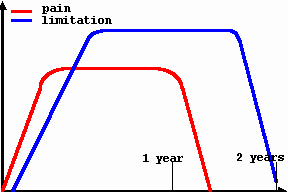
The disease has a spontaneous evolution of about two years.
Four periods of 4 to 6 months each can be distinguished:
- First increasing pain is followed by a progressively increasing limitation of movement. The pain and the limitation remain at maximum.
- During the second phase the condition progresses to one of severe pain (also intense nocturnal pain) accompanied by stiffness and decreased range of motion. The latter may be quite extensive and stiffening may increases to the point where the natural arm swing that accompanies normal gait is lost.
- After 8 months to a year, the pain starts to diminish.
The stiffness, however may still increase, though the pain is diminishing. Pain decreases at night, and discomfort occurs only at the extremes of motion, although movement is dramatically decreased. This stage lasts four to six months - The final stage, called the recovery stage, lasts from a two to six months and is characterized by minimal pain but severe restriction of movement. This latter stage is self-limiting, with a gradual and spontaneous increase in range of motion.
After two years pain has completely gone; there may remain some degree of stiffness. Approximately 7 to 15 percent of patients permanently lose their full range of motion but only a few have a true functional disability.
| [Start] | [Main shoulder] | [Flowcharts shoulder] | [A System of Orthopaedic Medicine] |
Copyright © 2021 DR. L. OMBREGT All Rights
Reserved
The author can not be held responsible for any damage caused by the use of any information provided.